FragLite: cyclin T
Some of the most important control switches sit on surfaces with no drug and no structure to guide us. Cyclin T, part of the transcription engine P-TEFb, recruits partners that tune when genes are switched on. We used our FragLite map, biophysics and AI modelling to pin down two of these elusive contacts — including one for the key regulator BRD4 — providing targets for future probes.
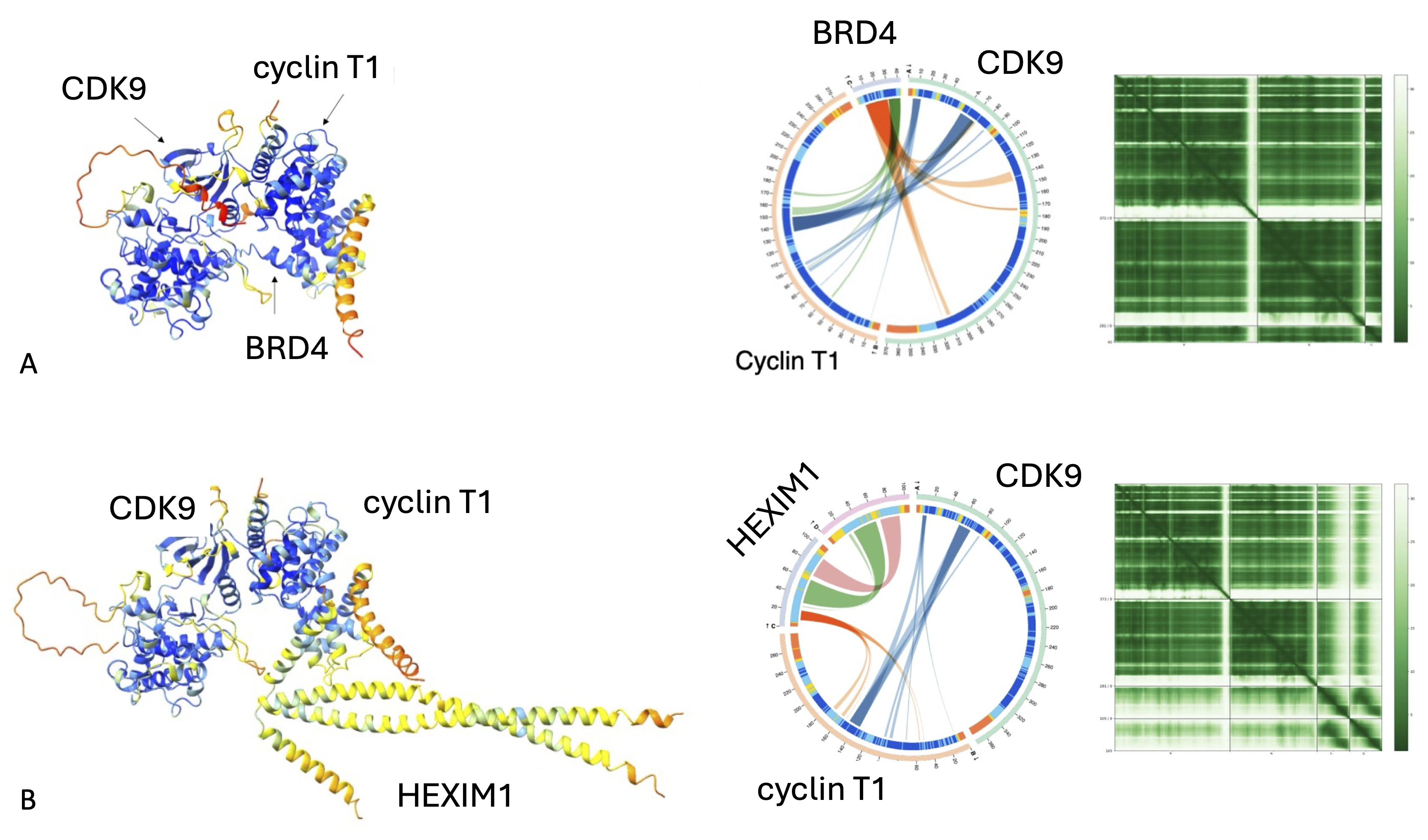
The eukaryotic positive transcription elongation factor b (P-TEFb), composed of CDK9 and cyclin T, plays a central role in regulating RNA polymerase II (RNAPII). Phosphorylation of the RNAPII C-terminal domain (CTD) by P-TEFb promotes promoter proximal pause release and enables productive transcriptional elongation across many genes. Cyclin T mediates protein-protein interactions, several of which have been structurally characterised, that help to recruit and fine-tune P-TEFb activity to ensure a tight regulation of transcription. In this study starting from the cyclin T FragLite map we demonstrated how FragLite binding sites colocate with the structurally defined binding sites for cyclin T partners CDK9, AFF4, and HIV-1 Tat. Two key cyclin T partners for which there is currently no experimentally determined co-structures are BRD4 and HEXIM1. BRD4 is an important cyclin T binding protein with an essential role in the regulation of transcription and HEXIM1 is a component of the 7SK snRNP that inhibits p-TEFb activity. By integrating FragLite clustering with biophysical analyses and AlphaFold3 modelling, we delineated the cyclin T-BRD4 interface and identified potential hot-spots that mediate HEXIM1 binding to cyclin T. These analyses provide a comprehensive, chemically enriched fragment map highlighting functionally relevant sites to support future probe and modulator development to selectively target P-TEFb.
Highlights of our study
- FragLite mapping of cyclin T1
- Identification of a BRD4 binding hotspot and site-selective mutant for functional studies
- AI modelling combined with FragLite mapping provide structural models to aid mechanistic studies
Collaborators: Colleagues at the CRH Newcastle Drug Discovery Group and Newcastle University Structural Biology Facility
PDB entries: 9ETP, 9ETB, 9ETA, 9ET9, 9ET8, 9ET7, 9ET6, 9ET5, 9ET4, 9ET3, 9ET2, 9ET1, 9ET0, 9ESY, 9ESZ, 9ESX, 9ESW, 9ESU, 9ESV, 9ESS, 9ESR, 9ESQ, 9ESP, 9ESO, 9ESN, 9ESL, 9ESK, 9ESJ
Associated publication: FragLite mapping to identify the BRD4 recruitment site of P-TEFb, (2026) Hope et al., bioRxiv 2026.04.09.717428; doi: https://doi.org/10.64898/2026.04.09.717428