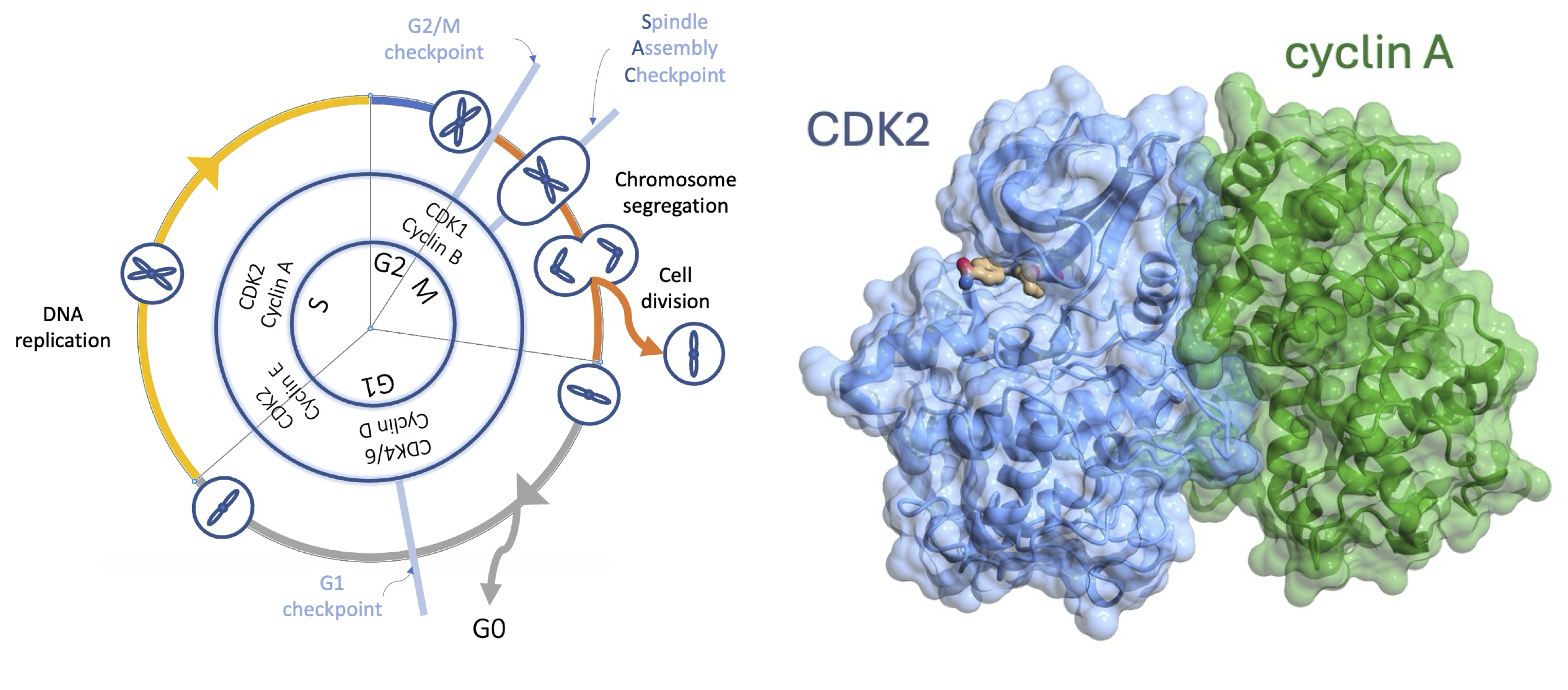
How does a cell decide when to divide, and carry that decision out so precisely? We answer this at the level of single atoms, using the structures of the cell's master regulators — the cyclin-dependent protein kinases (CDKs) — to work out how cell division and gene expression are controlled, and how that control fails in cancer.
Programme Leads: Jane Endicott and Martin Noble
Cells divide by passing through an ordered cycle — growing, copying their DNA, and splitting in two — with built-in checkpoints acting as quality-control gates. This cycle is driven by enzymes called cyclin-dependent kinases (CDKs), each switched on at the right moment by a partner cyclin; when this control breaks down, cells can divide uncontrollably, as in cancer. Right: the structure of one such switch in its "on" state — the enzyme CDK2 (blue) bound to its activating partner cyclin A (green) — the kind of molecular detail we determine to understand these machines and design drugs against them.