FragLite: CDK2-cyclin A
Can we find a protein's interaction hotspots before we know what binds there? We tested our FragLite chemical probes on a well-studied kinase pair, cyclin-dependent kinase 2 (CDK2)-cyclin A, as a benchmark. The fragments cleanly re-found every known protein-protein interaction (PPI) site and flagged one that had not been described — a route to guiding both mechanistic studies and new chemical probes.
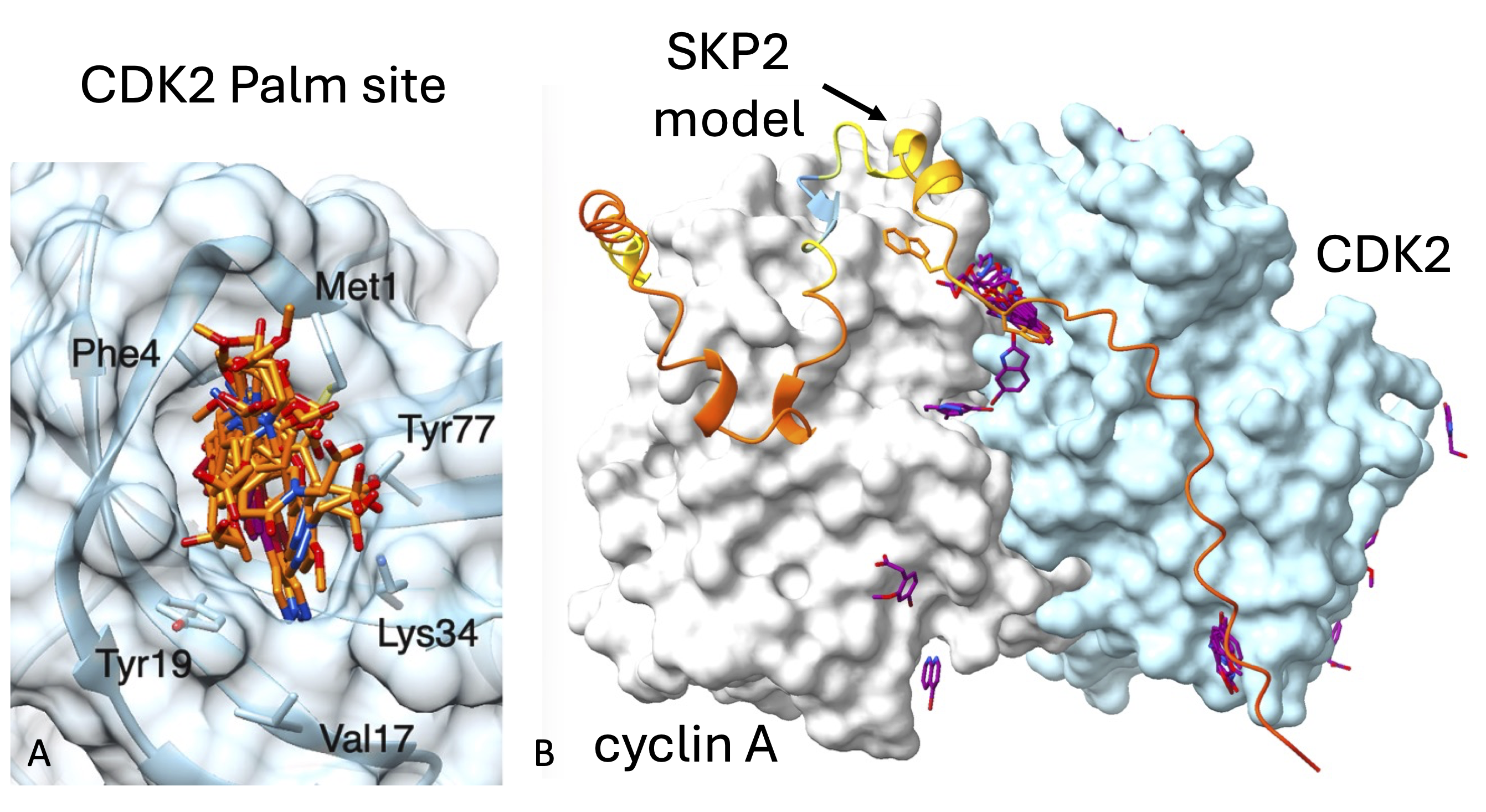
Sites of protein-protein interaction (PPI) are potentially more selective binding sites for therapeutics than protein substrate-binding sites. PPIs include distinct regions frequently called ‘‘hotspots,’’ sites of key amino acid interactions. Prospective identification of these hotspots through X-ray crystallographic screening could assist in the identification of separation of function mutants for experimental validation, enhance confidence in AI-generated multiprotein complex predictions, and accelerate development of selective chemical probes.
To explore these applications, we utilised the FragLite library to examine the binding surfaces of CDK2-cyclin A. The many protein- and peptide-CDK2-cyclin A complexes that have been structurally characterised make this complex an appropriate test case. We showed that FragLites comprehensively map both known sites of protein-protein interaction on CDK2-cyclin A and identified a possible uncharacterized site, providing a structural method toward directing mechanistic studies and starting points for chemical probe design.
Highlights of our study
- FragLites comprehensively map known sites of protein-protein interactions
- FragLites highlight residues to guide separation of function mutant selection
- FragLites can provide starting points for chemical probe development
- FragLites identify potential protein interactions sites to initiate functional studies
Collaborators: Colleagues at the CRH Newcastle Drug Discovery Group and Newcastle University Structural Biology Facility
PDB entries: 9ETP, 9ETB, 9ETA, 9ET9, 9ET8, 9ET7, 9ET6, 9ET5, 9ET4, 9ET3, 9ET2, 9ET1, 9ET0, 9ESY,9ESZ, 9ESX, 9ESW, 9ESV, 9ESU, 9ESS, 9ESR, 9ESQ, 9SP, 9ESO, 9ESN, 9ESL, 9ESK, 9ESJ
Associated publication: Crystallographic fragment screening of CDK2-cyclin A: FragLites map sites of protein-protein interaction, (2025) Hope et al Structure 33: 1-13. PMID: 40816275