CDK4-cyclin D3 structure
Not every kinase is switched on the same way. Cyclin-dependent kinase 4 (CDK4) drives the earliest step of cell division and is the target of approved cancer drugs, yet how it becomes active was unclear. Our structure of an authentic CDK4-cyclin D3 complex shows that binding a cyclin may not be enough to switch CDK4 on — a mechanism that departs from the textbook picture.
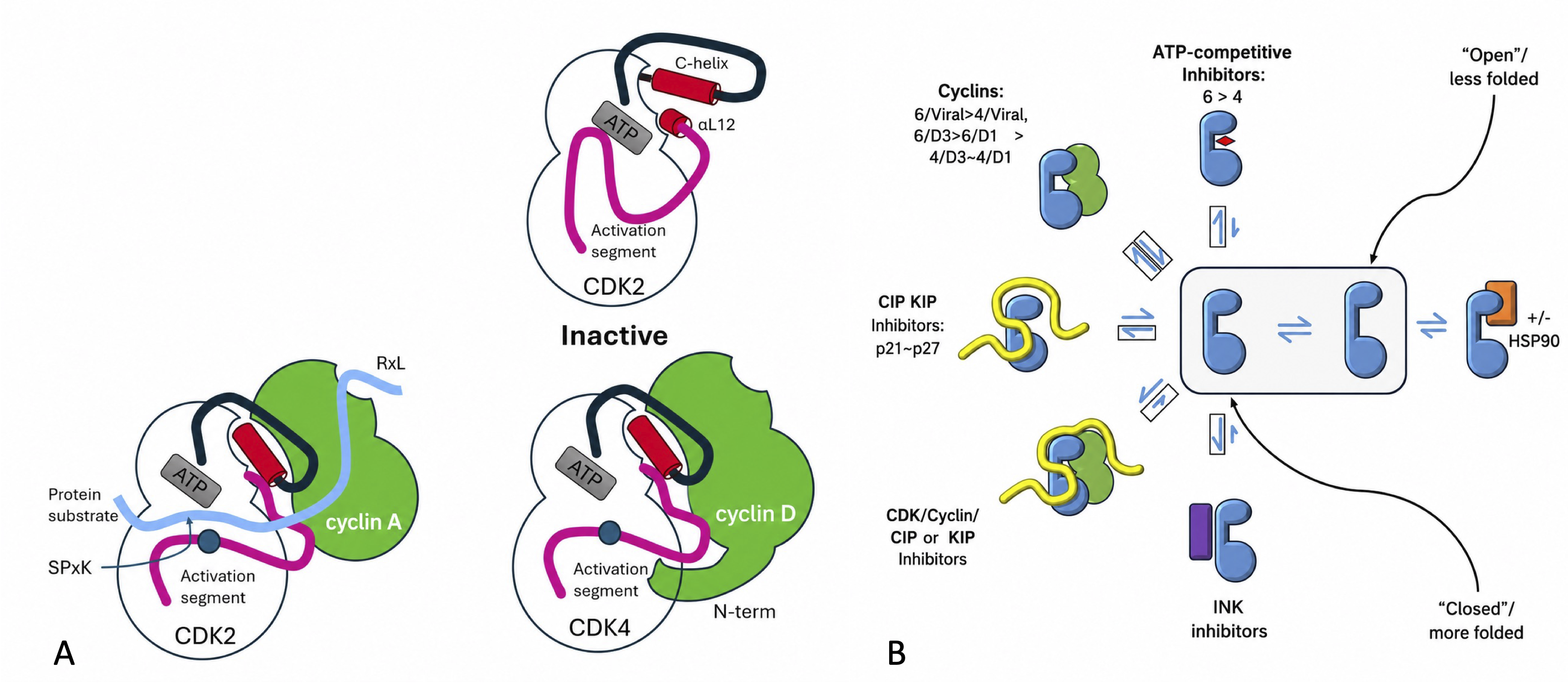
Cyclin-dependent kinase 4 (CDK4) and CDK6 are activated early in the G1 phase of the cell cycle upon expression of their cyclin D partners. Growth factor binding to receptors at the cell surface activates specific signalling cascades that culminate in increased transcription of the cyclin D genes. Assembly of a subset of CDKs into active complexes is tightly regulated by the Hsp90-Cdc37 chaperone system. We have demonstrated that CDK4 and CDK6 are differentially regulated by this system and hypothesize that there are multiple mechanisms whereby it may control formation of CDK4- and CDK6-cyclin complexes to impact their activities in normal vs transformed cell lines. Once formed, CDK4-cyclin D (and CDK6-cyclin D) complexes then principally phosphorylate the product of the retinoblastoma gene, pRb. CDK-dependent pRb phosphorylation results in dissociation of pRb-transcription regulator complexes and concomitant enhancement of expression of genes whose products are required for G1 progression.
To elaborate the molecular pathway of CDK4 activation and substrate selection we have characterised how CDK4 and CDK6 differentially engage with the HSP90-CDC37 pathway and have determined the structure of non-phosphorylated CDK4-cyclin D3. CDC37-HSP90 relinquishes CDK6 to D3- and virus-type cyclins and to INK family CDK inhibitors, whereas CDK4 is relinquished to INKs but less readily to cyclins. p21CIP1 and p27KIP1 CDK inhibitors are less potent than the INKs at displacing CDK4 and CDK6 from CDC37. However, they cooperate with the D-type cyclins to generate CDK4/6-containing ternary complexes that are resistant to cyclin D displacement by CDC37, suggesting a molecular mechanism to explain the assembly factor activity ascribed to CIP/KIP family members.
This structure of an authentic CDK4-cyclin D complex shows that cyclin binding may not be sufficient to drive the CDK active site toward an active conformation. Phosphorylated CDK4-cyclin D3 is active as a pRb kinase and is susceptible to inhibition by p27KIP1. Unlike CDK2-cyclin A, CDK4-cyclin D3 can be inactivated by treatment with lamda-phosphatase, implying that phosphorylated T172 is accessible to a generic phosphatase while bound to a cyclin.
Taken together, our results suggest that the structural mechanism of CDK4-cyclin D3 activation differs markedly from that of previously studied CDK-cyclin complexes. CDK4 and CDK6 are not essential genes but they are required for the development of certain types of cells. Deregulation of CDK4/6 activity by amplification of cyclin D or mutation of negative CDK4/CDK6 regulators is a frequent occurrence in a number of cancer types and as a result there are clinically approved CDK4/6 inhibitors.
Highlights of our study
- CDK4-cyclin D3 structure reveals that cyclin binding may not be sufficient to drive the CDK active site toward an active conformation
- The activity of CDK4-cyclin D3 toward pRb family members highly depends on substrate recruitment via cyclin D3
- The structural mechanism of CDK4-cyclin D3 activation differs markedly from that of previously studied CDK-cyclin complexes
Collaborators: Tim Hunt and Laurence Pearl
PDB entry: 3G33
Associated publications:
The structure of CDK4/cyclin D3 has implications for models of CDK activation, (2009) Takaki et al., Proc. Natl Acad. Sci. 106: 4171-4176. PMID: 19237555
Differential regulation of G1 CDK complexes by the Hsp90-Cdc37 chaperone system, (2017) Hallett et al., Cell Repts 21: 1386-1398. PMID: 29091774