SKP2–p27KIP1 recognition
How does a cell tell one near-identical partner from another? The degradation machine SKP2 must pick out cyclin A from its close relatives to release the brake protein p27KIP1 at the right moment. We found that SKP2 grips cyclin A in more than one way, using a site that cyclins B and E lack — a molecular basis for this specificity.
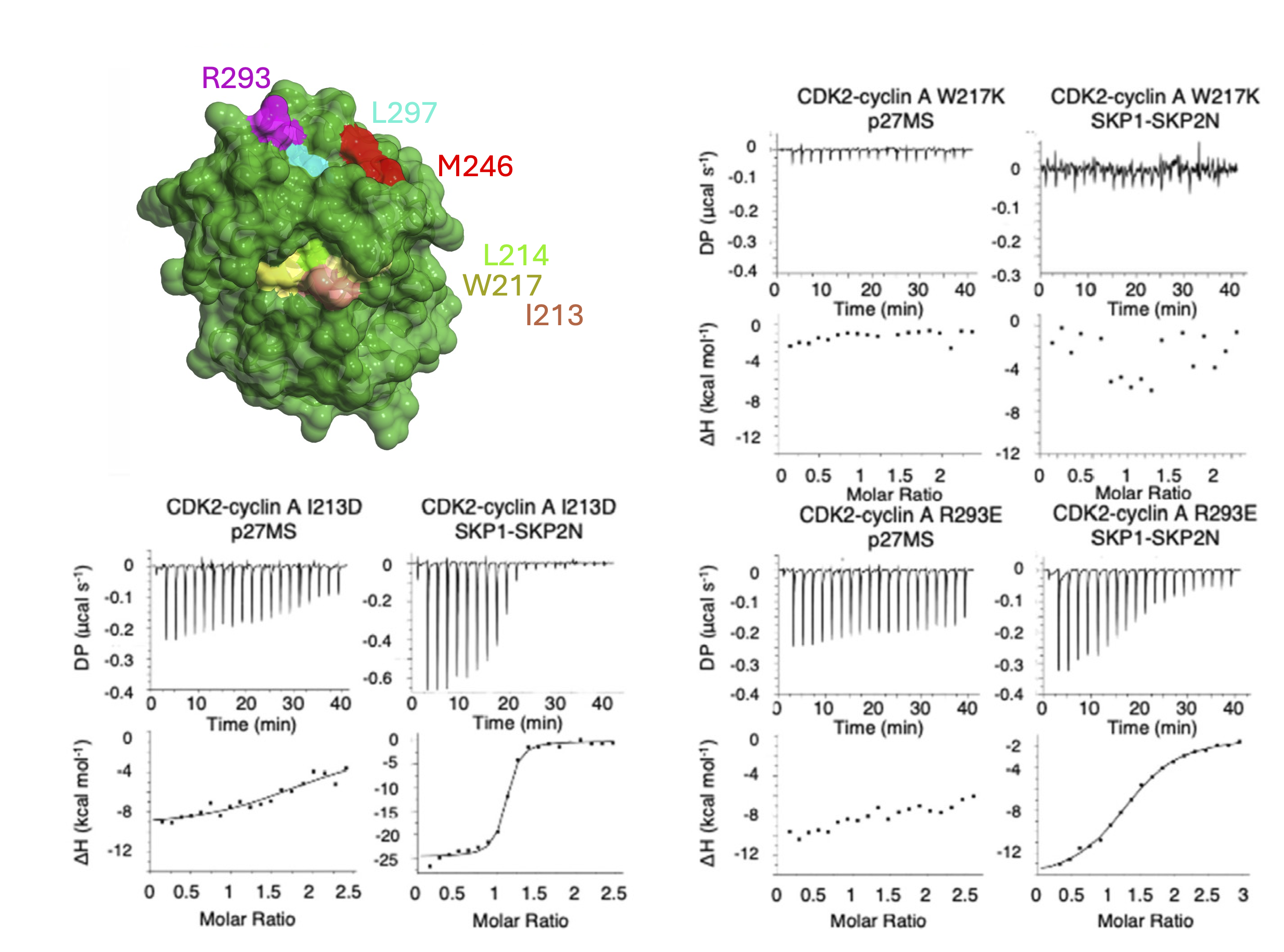
The SCFSKP2 ubiquitin ligase relieves G1 checkpoint control of CDK-cyclin complexes by promoting p27KIP1 degradation. We have reconstituted stable complexes containing SKP1-SKP2 and CDK1-cyclin B or CDK2-cyclin A/E, mediated by the CDK regulatory subunit CKS1 and shown that a direct interaction between a SKP2 N-terminal motif and cyclin A can stabilize SKP1-SKP2-CDK2-cyclin A complexes in the absence of CKS1. This work demonstrated that SKP2 competes with p27KIP1 for binding to the cyclin A recruitment site and identified a SKP2 binding site on cyclin A that is absent from cyclin B and cyclin E. Notably, this site is distinct from but overlaps with features that mediate binding of p27KIP1 and other G1 cyclin regulators to cyclin A. We propose that the capacity of SKP2 to engage with CDK2-cyclin A by more than one structural mechanism provides a way to fine tune the degradation of p27KIP1 and distinguishes cyclin A from other G1 cyclins to ensure orderly cell cycle progression.
Highlights of our study
- Identification of a SKP2 binding site on cyclin A
- Mechanism by which SKP2 distinguishes cyclin A from cyclins E and B
- SKP2 binds at the cyclin A recruitment site via a non-canonical SLiM motif
Collaborators: Frank Sobott, Stefan Arold and Michel Pagano and Colleagues at the CRH Newcastle Drug Discovery Group
PDB entry: 6SG4
Associated publication:
Discriminative SKP2 interactions with CDK-cyclin complexes support a cyclin A-specific role in p27KIP1 degradation, Salamina et al (2021) J Mol Biol 433:166795. PMID: 33422522