p16INK4a nanobodies
Many cancers switch off a protective protein simply by making it fall apart. The tumour suppressor p16INK4a (p16) is often crippled by mutations that destabilise its fold. We show that small camelid antibodies (nanobodies) can prop these mutants back up without blocking p16's normal job — raising the possibility of rescuing a disabled tumour suppressor.
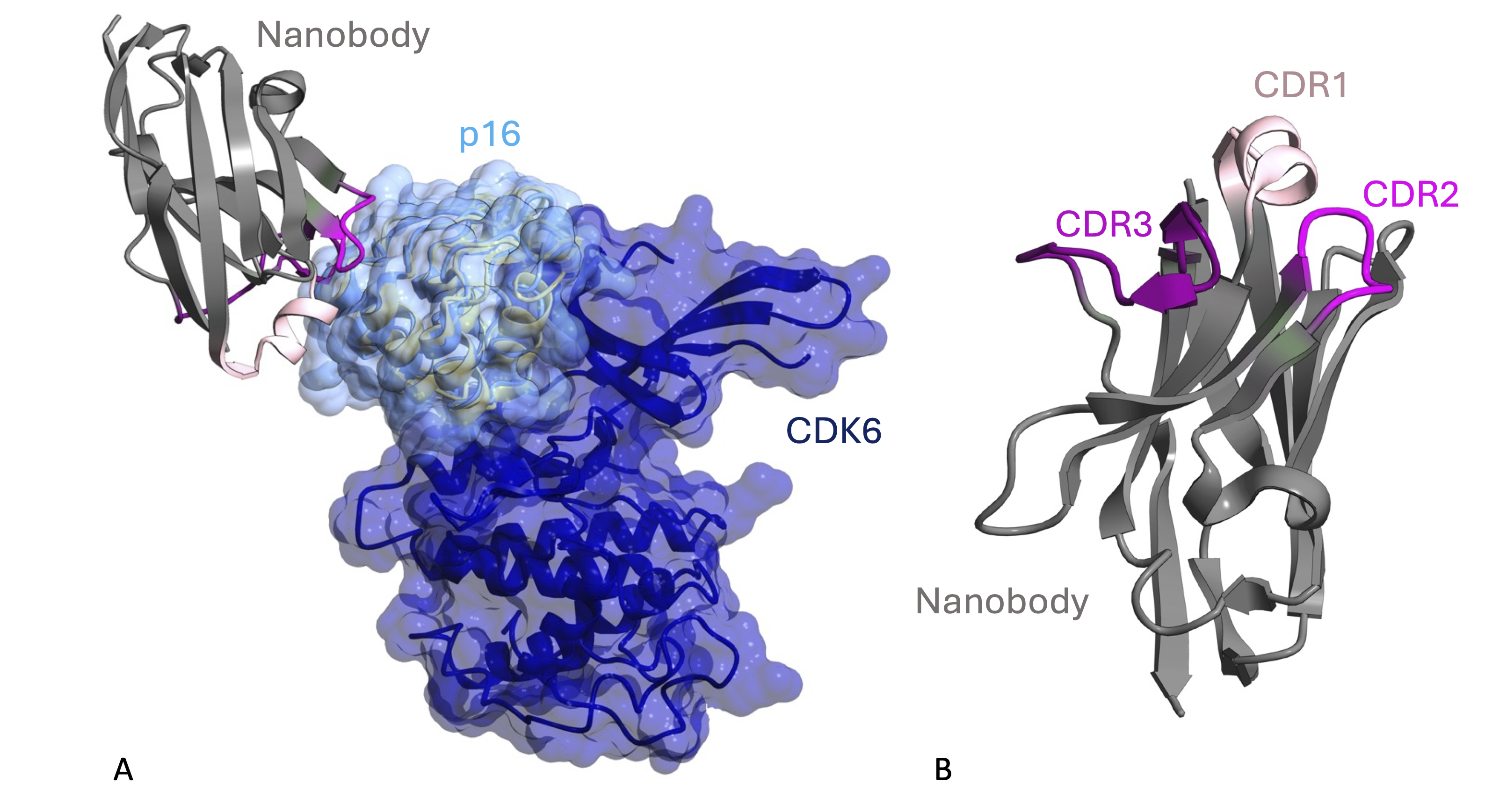
In this study we described the generation and characterisation of camelid single-domain antibodies (nanobodies) raised against tumour suppressor protein p16INK4a (p16). p16 is a cell cycle regulator that inhibits CDK4 and CDK6 and is inactivated in sporadic and familial cancers. The majority of p16 missense mutations cause loss of function by destabilizing the protein’s structure. Our collaborator Prof Laura itzhaki identified nanobodies that bind p16 with nanomolar affinities and restored the stability of many different cancer-associated p16 mutations located at sites throughout the protein. The crystal structure of a nanobody-p16 complex reveals that the nanobody binds to the opposite face of p16 to the CDK-binding interface permitting formation of a ternary complex. We confirmed that nanobodies bind to p16 in a cellular setting and do not preclude p16 binding to CDK6 and its ability to induce cell-cycle arrest. These findings indicate that nanobodies merit testing as pharmacological chaperones for p16 reactivation in the cell.
Highlights of our study
- Describes a nanobody (single chain antibody) that binds tumour suppressor protein p16
- Nanobody binding can stabilize wildtype and cancer-associated p16 mutants
- p16-nanobody crystal structure reveals interactions compatible with p16-CDK6 binding
Collaborators: Laura Itzhaki and colleagues at the CRH Newcastle Drug Discovery Group and Newcastle University Structural Biology Facility
PDB entry: 7OZT
Associated publication: Nanobodies restore stability to cancer-associated mutants of tumour suppressor protein p16INK4a, (2025) Burbidge et al Structure 33: 1984-1997. PMID: 40816278