Facilities
Equipment
The Wolfson Archaeology Laboratory is equipped with a wide range of facilities for analysis of archaeological materials and artefacts. This includes:
- Facilities for soil analysis, pollen, phytolith and other microfossil sample preparation
- Furnaces for research into material culture, archaeo-materials and ancient technologies through experimental archaeology
The laboratory has a microscopy suite for the analysis of particular types of materials:
- A suite of stereo-microscopes for artefact analysis including Leica EZ4 W microscopes with integrated Wifi cameras
- A Leica M205C stereo-microscope: an unrivalled combination of high resolution and depth of field, enabling detailed analysis and imaging of 3D objects and surfaces. It is the world’s first stereomicroscope to achieve an optical resolution of 0.952 µm. Motorised focus and software enable z-stacking for superior imaging capabilities
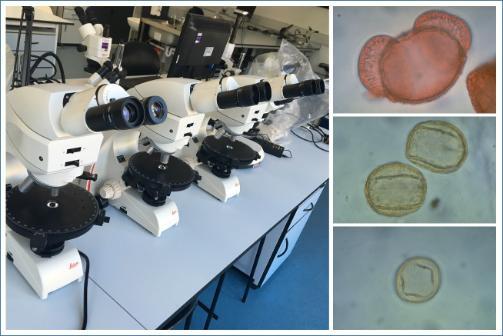
- A suite of state-of-the-art Leica DM750P polarising microscopes for petrographic and thin section analysis
- A Leica trinocular DM750P polarising microscope with ICC50 camera and reflected light module for a wide range of petrographic and materials analysis applications
- A bespoke Leica DM2700 MH RL microscope with MC170 HD Camera and SW Kit. This microscope has been designed specifically for use-wear analysis of large metal objects
-
A Keyence VHX 7000 digital microscope with articulated arm, suitable for use as an upright microscope or to examine large objects up to 6000x magnification
- A Leica DM6 B TL/BF fluorescence microscope with Flexacam C1 camera. The Leica DM6 B is a fully automated system with the full range of analytical capabilities including transmittance, polarising options and automated and programmable switching between contrast methods. LAS X Navigator software enables the full range of measurements, tile scan aquisition and image stitching. This microscope enables advanced analysis of autofluorescent materials with applications including assessment of burnt bone, preservation of wood, phytolith analysis and more
- Portable electronic GXM - Dino-Lites AM4815ZTL for in situ artefact analysis
- Olympus BH50 biological microscopes for pollen and microfossil analysis
Our spectroscopy suite enables compositional analysis of materials:
- Leica DM6 with integrated Laser Induced Breakdown Spectroscopy. This enables high precision spot characterisation of samples such as uncovered thin section slices and samples of glass and ceramics, simultaneously with high resolution imaging
- FT-IR spectroscopy: ThermoFisher Summit Pro with Diamond ATR. This portable FT-IR system is capable of both transmittance and ATR modes and can provide compositional data on a wide range of materials in the lab, museum or field
- Portable XRF Bruker Tracer III-SD analyser and Bruker Tracer 5g. Our workhorse instruments enable rapid assessment of bulk materials in the lab or in the field
Our Artec 3D scanning systems enables us to produce 3D models both for virtual space and to reproduce objects for research and educational purposes. The Wolfson Archaeology Laboratoy hosts a range of Artec scanning systems including the Artec Eva scanner that uses structured light scanning to scan objects up to 61,000cm3 with a resolution of 0.5mm; the Artec Micro for scanning small objects (max. 324cm3) with a resolution of 10 microns; Artec Space Spider medium sized objects (max. 2000cm3) with a resolution of 0.1mm and the Artec Leo for larger monumental objects (160,000cm3) with a resolution of 0.5mm.
A dedicated research room is available for postgraduate and postdoctoral research.
Reference Collections
We have a wide range of reference material for teaching and research, including the zooarchaeology teaching collection (focusing on domesticates), historic and prehistoric artefacts (including glass, ceramics, metals), Roman pottery collections, and an extensive range of microfossil material from the UK. Our research room is also home to our human osteology collection.
Other analytical facilities
Archaeologists also have access to advanced analytical facilities through NEXUS, the the Engineering and Physical Science Research Council (EPSRC) mid-range facility in X-Ray Photoelectron Spectroscopy (XPS). NEXUS facilities include SEM-EDX, ToF-SIMS and Raman microscopy. For full details on techniques available see here.
For the analysis of organic materials, such as food residues in pottery, Archaeology collaborates with the Biogeochemistry laboratories in Civil Engineering and Geosciences. Facilities available include GC-FID, GCMS and GCcIRMS.