
Psychological Safety
.jpg "Graphic depicting the focus group's exploration of psychological safety and the many things affecting it")
Creating Space to Speak: What Our Colleagues Helped Us See
Dawn Roxburgh: Organisational Development
What does psychological safety mean for our colleagues?
It all started back in autumn 2025, as we were reflecting on how the term psychological safety was being received by colleagues across the organisation. It had become so familiar to us as a team, having spent the last 18 months researching, exploring and understanding the concept, we were at risk of becoming over familiar with the term. In addition, we had received feedback from some colleagues that the term was problematic.
One of my personal statements for reflection and something you might hear me saying is “the obvious is not always obvious”. I started to ask myself, through our learning and research had we become too familiar with the term and created our own echo chamber? Were we missing how the concept was being received as we had become so familiar with it? How could we check our assumptions?
From assumptions to answers: Learning about psychological safety together
To better understand how this term was being perceived in our context we identified it would be good to run a set of focus groups across the organisation to listen to our colleagues and understand their views. Rather than advertising the focus groups as discussions about psychological safety we took into account Professor Amy Edmondson’s definition* of Psychological Safety to develop our question “How would you describe work environments where you believe you have been able to take interpersonal risks, or speak up with ideas, questions, concerns or mistakes”
We ran three focus groups across December 2025 and January 2026, two in person on our campus and one online. They were open to all colleagues and advertised internally through MS Teams and The Research Space.
*Edmondson, A. (1999). Psychological Safety and Learning Behavior in Work Teams. Administrative Science Quarterly, 44(2), 350-383.
Capturing the outputs in different forms
To capture an alternative form of voice we wanted to record the outputs visually. We engaged with a local illustrator Inky Thinking, to explore if this was possible. They have been absolutely brilliant, from start to finish, from engaging with us in terms of understanding and scoping the requirements, providing a very competitive quote, being extremely understanding and flexible in terms of dates for our sessions (If you have ever planned a focus group, you will empathise!) and producing a set of fantastic illustrations for us representing our focus groups.
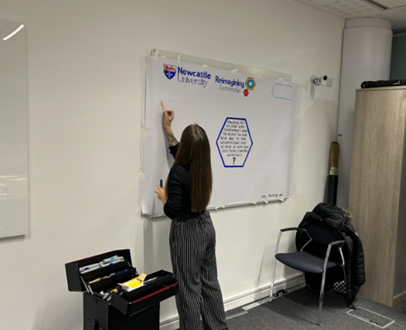
Our thought process to make it happen
So how did we make it happen? We started with a planning session and asked ourselves the following questions:
Session logistics and structure:
- How many people would make your focus group a success?
- What is your question for the group?
- Can you test your question out with a colleague?
- How long do you want the focus group to last?
- Where do you want the focus group to take place, in person, hybrid or online only?
- If online, how will you invite everyone/set up the meeting link?
- If in person, what is the room like?
- Do you need to book a room?
- Who will facilitate the session?
- What is the plan for the session, do you need to document a session plan?
- How will the session be structured?
- How are you going to recruit colleagues?
Output:
- How do you want to capture the outputs?
- Do you want to record the session?
- How will you capture consent?
- Do you plan to anonymise data and insights to protect confidentiality?
How we made spaces for all voices during the session
We started with a brief introduction, our names and the area of the University we work in. We then created shared ground rules. This is a process of contracting with a group, by asking the group what they need to make the session a success can make the implicit, explicit. This is a practice that, built into sessions helps create rapport and trust at the start of the session. Session agreements, or ground rules can be practical things (examples include agreeing that people can leave the room if needed and finishing the session on time) or behaviours and actions (examples include assume good intent, and confidentiality agreements). We started with a blank flip chart and agreed the ground rules with the group before moving onto the focus of the session.
To make spaces for all voices we used the practice of conversational turn taking, this practice gives everyone the opportunity to speak about the subject, enabling all voices in the group to be heard. We started by explaining the process, that we would all take turns to speak, answering the focus group question. It is important to also make it clear to participants that they can pass and come back to their turn. After one round of conversational turn taking, we invited group participants to add additional thoughts and build on what had been said.
The practice of conversational turn taking not only invites all voices to be heard it also supports active listening, as participants gain awareness of the process, they recognise they will get a turn to speak and therefore can actively listen to others in the room, concentrating on what people are saying rather than thinking about how and when they will get to contribute to the discussion.
Building safer teams starts with listening: what leaders can learn when they ask
Our learnings are captured in the illustration, which can be used to promote rich discussions with leaders and teams.
What is clear is that building safer teams starts with listening and to listen leaders need to ask. By listening I mean listening to understand: have you ever listened to someone and heard the words but not what they are saying? How many times do you listen to a team member, but you are thinking about your next meeting or how you are going to reply?
Listening with care is important to create and foster psychological safety and it helps build rapport leading to the creation of safe spaces. Psychological safety is fostered by the development of relationships over time, not empty words. Our people feel safe to speak up and take an interpersonal risk when they trust those around them.
One last thing
I want to finish by saying thank you to our colleagues that took part in our focus groups, these insights gave us grounding, supporting our research and helped create a deeper understanding of what it means to take an interpersonal risk at Newcastle University.
Creating, building and maintaining psychological safety is complex work, it is different for everyone, dynamic and there is no quick fix, what is important is creating spaces for leaders and teams to ask, pause, listen, reflect and act. This is ongoing work that deserves attention.
I hope these insights and reflections support others to create the time and spaces to hold discussions and ask similar questions within their own teams and organisations.