
FAQs

Mailing list
Please help us to keep track of who is using the BEST resources and/or sign up to our mailing list.
Why do SLTs need to assess eligibility?
BEST was developed as a specialist intervention for children with significant language difficulties or disorder. These children often have complex needs and difficulties in other areas of language and development such as social communication disorders, hearing impairment and speech sound disorders which may limit their ability to engage with and benefit from BEST. SLTs have the knowledge and expertise to identify these needs and decide if BEST is a suitable approach. If SLTs are not involved in this process children with previously unidentified needs and disorders may not receive timely diagnoses and the correct support may not be put in place.
Can schools administer the Eligibility Assessment if a child is already known to Speech and Language Therapy services?
In some cases, if schools have a close relationship with SLT services and following discussion with a child’s SLT, school staff may administer the eligibility assessment if the SLT agrees that it would be suitable for the child.
What is meant by ‘significant or severe language difficulties or disorder’?
In the context of BEST, we mean children who are unable to produce multiword sentences made up of three or more parts. By the age of three, most children can put words together to form a range of meaningful sentences that have multiple elements. For example, “the boy gave the apple to the man” is a sentence with four elements. However, some children can find forming sentences like this very difficult and may communicate mainly with single, two, or three-word sentences made up of only one or two parts (“the man go”, “me sit”). The following link from Speech and Language therapy UK provides helpful information about typical ages and stages for language development which may help you think about the children in your setting who may be struggling with language. https://speechandlanguage.org.uk/help-for-families/ages-and-stages/
If children are able to wander around during the session are the signs important?
The ideal situation is for the children to be sitting and attending during the BEST sessions but we know some children like to wander and as long as they can still hear what is going on there is no problem with them doing that.
Signing is optional but our research comparing BEST with sign and without showed the signs did make a positive difference, so we recommend using them if possible.
Do all children need to do all sentences in the output phase?
BEST was designed for all children to do all of the sentences but we have shown that it still works if each child does a different sentence, this may be necessary if children have short attention spans or behavioural issues.
We recommend the original approach is used if possible, as literature on dosage suggests that children should do as many repetitions as possible during a session.
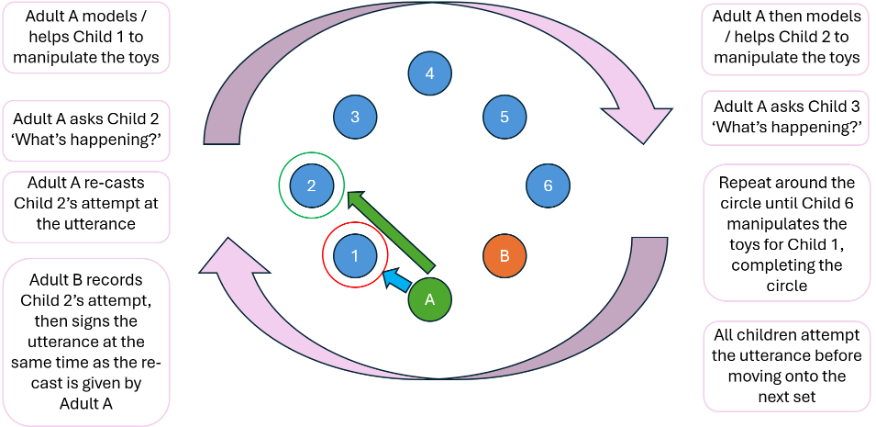
The original approach is:
Step 1: signal to the children that this is their turn to say what the people are doing
Step 2: support child 1 to carry out the action with the toys for output sentence 1
Step 3: while child 1 is carrying out the action with the toys, the adult asks child 2 sitting next to them “what is happening?”
Step 4: Accept whatever response is given by child 2 and say the target sentence (“yes, the teddy is washing the apple”) If the child does not respond after a short gap say the sentence.
Step 5: record child 2’s response in the BEST therapy record booklet (Spontaneous responses of other chidren in the group should also be recorded)
Step 6: Support child 2 to carry out the action for sentence 1
Step 7: While child 2 is carrying out the action, ask child 3 sitting next to them “what is happening?”
Step 8: Continue round the circle until all children have completed sentence 1
NOTE: It is not necessary for all children to respond, avoid repeating the question, demanding a response or scaffolding children’s responses. Avoid using additional verbal praise
Move on to sentence 2. Continue around the semi-circle repeating steps 2-8 until all children have attempted all the sentences and the full set has been completed.
Return to the input phase for the next set of sentences. Remember to introduce any new toys and noun vocabulary
Which signs should I use when delivering BEST?
We have recommended using Makaton for content words and Paget Gorman for morphology but the practitioner can use whichever signs are easier for them as long as all parts of the sentences are signed. It is fine to code switch, you can move between the different types of sign. Paget Gorman signs are shown on our website and you can find out about Makaton here: https://makaton.org/
Can we use our own images in homework?
You should use the homework and images we provide as they were designed with consideration for issues that may not be obvious. The images represent a diverse community and can be easily interpreted by families. We have ensured that there is consistency across the images and there are embedded cues, for example the agent is coloured in each image.
We recommend you do not change the images but you could supplement them with additional resources/images.
Who should deliver the homework?
The homework can be delivered by families or practitioners. We see the homework as a bonus, it is good for families and/or practitioners to do this with the child, but it is not essential.
If the child does not respond during an assessment is this scored as 0?
Yes, if the child does not respond this is scored as 0. We did consider missing out the questions with no response when scoring but this is complicated and would result in more errors. A non response can mean something so it important for this to be shown in the scoring. We know that some children may be shy so may not reply, in this case it will do them no harm to attend a group for a while and receive BEST. They will soon reach the level at which they can be discharged.
Why can’t autistic children use BEST?
BEST uses joint attention and play based activities to support language development. Autistic children may have significant difficulties in these areas and therefore will be unlikely to benefit from the program. Alternative, specialist support may be required for these children.
Is training available?
Training on Building Early Sentences Therapy (BEST) is available via Course Beetle. Discounted pricing is available for students and returners to the profession.
This is available as two training packages:
- Firstly, the BEST – Listen to Learn is a comprehensive package for Speech and Language Therapists wishing to deliver BEST, and to supervise Early Years staff, assistants and others under direct supervision delivering the therapy.
See https://coursebeetle.co.uk/courses/best/ for more details
- Following completion of the above training, BEST for settings is also available for Speech and Language Therapy Services wishing to implement BEST in their locality.
See
BEST assessment and therapy documentation are available free of charge on this website
The training available from Course Beetle includes added value in the form of videos, MAKATON demonstrations, practical demonstrations and other resources developed to support those wishing to understand and apply BEST. These resources are designed to complement the free resources.
BEST – Listen to Learn
- Web-based self-directed study section including:
- Bite-sized videos of Dr Sean Pert explaining the theory of this evidence-based language therapy
- A live online session with Dr Sean Pert, one of the authors of the BEST.
- Pose questions about delivery
- Evaluate your understanding of the programme and underlying theory and practical delivery with quizzes with detailed answers and explanations
- Demonstrations with BEST toys sets.
- Resolve any queries about the practical delivery of the BEST programme.
BEST for settings
This low-cost training is aimed at Early Years staff, classroom assistants and others delivering BEST under the supervision of a BEST trained Speech and Language Therapist. The training includes:
- An overview of the available resources
- Summary information about BEST
- An introduction to signing for BEST
- Reference videos for all the Makaton signs used with BEST
- Viewable and downloadable session record sheets and signing crib sheets
- Viewable and downloadable homework booklets