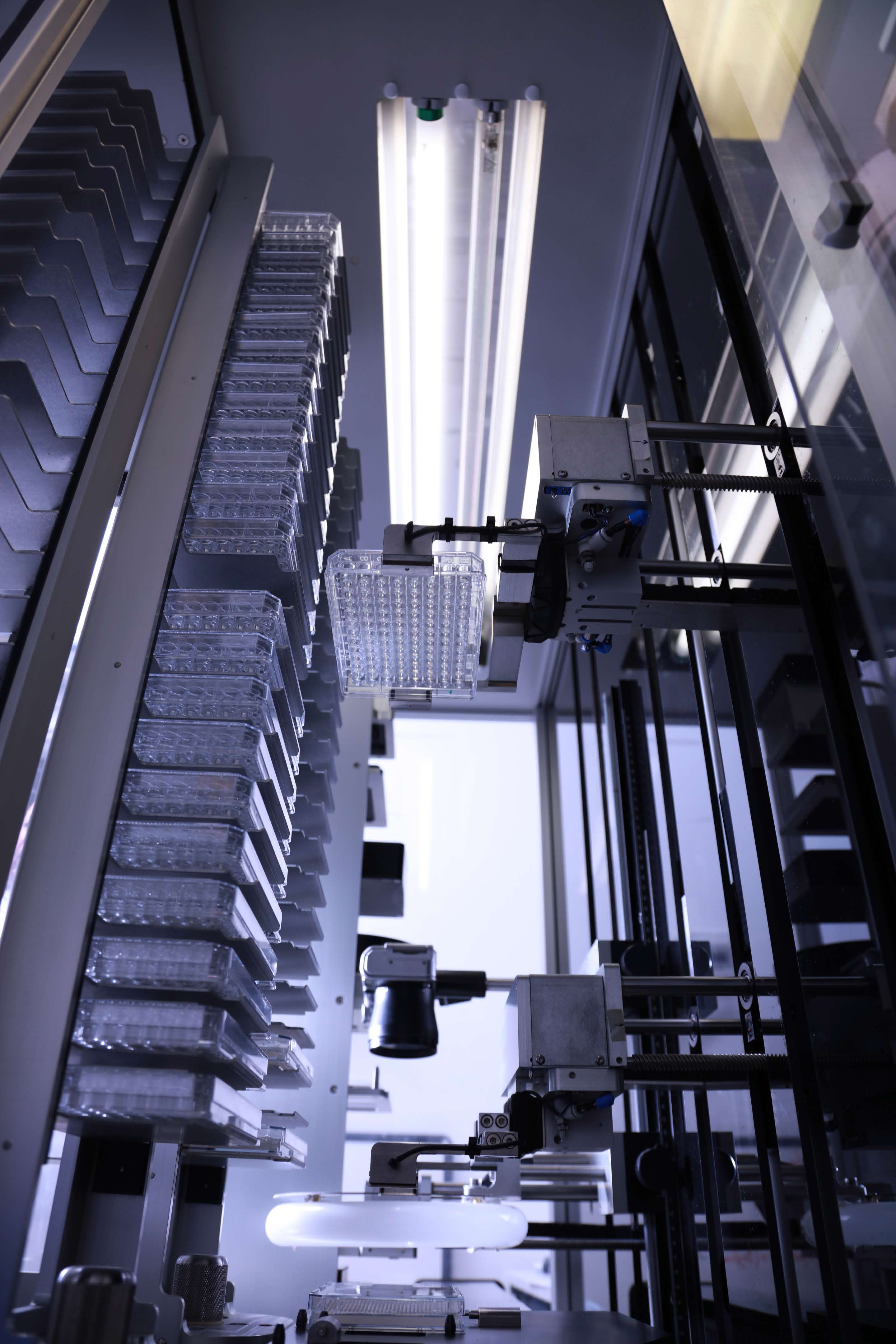
We are a high-throughput biological screening facility based in the Lydall lab in Newcastle University. We offer access to a wide range of robotic equipment for carrying out high-throughput biological screens. We can also assist with high-throughput experimental design and quantitative analysis.
We have recently had an article published describing the application of our robots and analysis techniques to studying telomere biology in Saccharomyces cerevisiae which is freely available for download here:
Beckman Biomek FX Liquid Handler: Transfers liquids and cultures. 96 well and span-8 (1-8 channel) liquid handling tips allow precision liquid handling. Can inoculate cell cultures from liquid medium into liquid or onto solid agar (e.g. for Quantitative Fitness Analysis [1,2] (QFA)). A stacker allows use of up to 189 plates per run.
Biomatrix BM3-09 Colony Handler: Transfers microbial cultures in 1, 96, 384 or 1536 colony formats from solid agar to solid agar (e.g. for Synthetic Genetic Array [3] (SGA) screening) or to liquid culture. The BM3 can replicate or re-array libraries and revive frozen libraries. A stacker allows use of up to 192 plates per run.
Matrix WellMate Dispenser: For rapid, sterile dispensing of liquid in 96 or 384 well format, in volumes from 1 ul to 2000 ul.
spImager: High resolution agar plate imaging system ensuring uniform illumination and reproducible plate positioning. High quality image capture for publication and/or subsequent image analysis (e.g. cell density quantification [1]).
S&P Robotics Automated Incubators: High-throughput, automated time-course photographic system, allowing 24-7 imaging of up to 192 agar plates (from May 2011)
Synthetic Genetic Array (SGA): In SGA we combine background gene mutation(s) with all non-essential null mutations in the budding yeast genome to produce ~5000 different mutant yeast strains. SGA permits an estimate of combined mutation fitnesses [3].
Quantitative Fitness Analysis (QFA): QFA accurately determines fitness of microbial cultures and can assess the effects of genetic, drug, temperature or nutrient interventions. In QFA culture growth is monitored on agar plates by time-lapse photography and image analysis (using Colonyzer [1]). Typically we quantify cell density of 384 independent cultures per plate. Dynamic modelling of observed densities provides quantitative estimates of exponential-phase growth rate, saturated culture density and fitness for mutant libraries.
Libraries and Culture Handling: We hold the single-deletion and GAL overexpression libraries in S. cerevisiae. These are appropriate for high-throughput screens to determine specific genetic interactions, and we are happy to discuss the purchase of other libraries. We can also handle many other biological materials (e.g. siRNA, bacterial, S. pombe or mammalian cells).
Robotic Usage Costs: Cost for robot time including technician is around £35 per hour. Please contact us for precise estimates.